NSF Water Filter Certifications: A Homeowner’s Guide

For home water filters, the certifications that matter most are NSF/ANSI 42 (taste and odor), NSF/ANSI 53 (health contaminants including lead), NSF/ANSI 58 (reverse osmosis systems), and NSF/ANSI 401 (emerging contaminants like certain pharmaceuticals and PFAS-adjacent compounds). The fastest verification step: look up your exact filter model in the NSF Certified DWTU directory and open the product’s Performance Data Sheet to confirm what was actually tested and at what capacity.
Quick reference by concern:
- Lead in your water → look for NSF/ANSI 53 with an explicit lead reduction claim
- PFAS contamination → check NSF/ANSI 401 listings and certifier directories; packaging alone is not enough
- Reverse osmosis system → NSF/ANSI 58 is the governing standard
- Chlorine taste or odor → NSF/ANSI 42 covers aesthetic effects
- Microbiological risk (well water or boil notices) → NSF/ANSI P231 or NSF/ANSI 244
The single most important rule: a certification mark on the box only tells you a certifier tested something about that filter. The Performance Data Sheet tells you what was tested, at what challenge level, and for how long. Always read both.
Key Takeaways
NSF/ANSI certification is voluntary and claim-specific — always verify at the model level using the certifier’s directory and the product’s Performance Data Sheet, not the packaging alone.
| Point | Details |
|---|---|
| Match standard to contaminant | Use NSF/ANSI 53 for lead, 401 for PFAS, 58 for RO systems, 42 for taste and odor. |
| Verify at the model level | Look up your exact model in the NSF Certified DWTU directory before purchasing. |
| Read the Performance Data Sheet | The sheet shows tested contaminants, challenge levels, reduction percentages, and rated capacity. |
| Replace filters on schedule | A certified filter past its rated gallon capacity no longer performs to its tested claims. |
| Use local data first | Tapwaterindex shows which contaminants are detected at your utility, so you prioritize the right certifications. |
Official directories and trusted resources
These are the primary sources to use when verifying filter certifications or learning more about specific standards:
- NSF Certified DWTU Directory — search by standard, product type, or model number; lists claims, capacities, and service-life data for certified units
- NSF Water Filtration Certification Overview — explains the range of applicable standards and links to certified product listings
- EPA Guide: Filters Certified to Reduce Lead — step-by-step consumer tool for identifying lead-reduction certified filters, with guidance on NSF/ANSI 53 and 42
- EPA Guidance: Filters Certified to Reduce PFAS — directs consumers to certifier listings and validated test methods for PFAS reduction claims
- ANSI Blog: NSF/ANSI Drinking Water Treatment Standards — plain-language summaries of NSF/ANSI 42, 53, 58, 177, 244, and 401 and their intended product scopes
- UL Solutions: Water Filtration Certification — documents UL’s ANSI-accredited certification services and the overlap with NSF/ANSI standards
- Tapwaterindex Contaminants Guide — explains EPA limits and contaminant prevalence to help you map local results to the right certification standards
Table of Contents
- NSF/ANSI water filter certifications explained: what they actually guarantee
- Common NSF/ANSI standards for home filters and what each one covers
- How filter testing and performance claims actually work
- Step-by-step: how to verify a filter’s certification before you buy
- How to read certification marks, packaging text, and the Performance Data Sheet
- Identifying filters certified to reduce PFAS
- When to prioritize which certifications: use local water data to decide
- Check your local water before choosing a certified filter
- Sources
NSF/ANSI water filter certifications explained: what they actually guarantee
NSF International notes that residential water treatment filters carry no federal regulation — manufacturers pursue certification voluntarily. That matters because it means a filter without a certification mark has not been independently tested at all, and a filter with one has been tested only to the specific claims listed on its Performance Data Sheet.
Certification is conducted by ANSI-accredited third-party organizations. NSF International is the most recognized, but UL Solutions, IAPMO R&T, and WQA also certify products to the same NSF/ANSI standards. Any of them is credible when model-level proof exists.
Three things a valid certification actually guarantees:
- Materials safety: the filter components don’t leach harmful substances into the water at tested flow rates and temperatures
- Structural integrity: the housing won’t fail under normal operating pressure
- Verified contaminant reduction: the filter reduced the tested contaminant(s) to the claimed level, at the stated challenge concentration, for the rated service life
Three things it does not guarantee:
- That the filter removes every contaminant — each standard covers a defined list, and a filter certified to NSF/ANSI 42 for chlorine taste is not tested for lead
- That performance holds if you skip filter replacement — certification is tied to the rated capacity stated on the Performance Data Sheet
- That your tap water matches the lab’s challenge concentration — real-world influent varies, and a filter tested at 150 ppb lead may perform differently if your water runs at 300 ppb
Pro Tip: When you read a certification claim on packaging, immediately ask: “Certified for what, specifically?” If the packaging doesn’t name the standard number and the specific contaminant, the Performance Data Sheet inside the box will.
Common NSF/ANSI standards for home filters and what each one covers
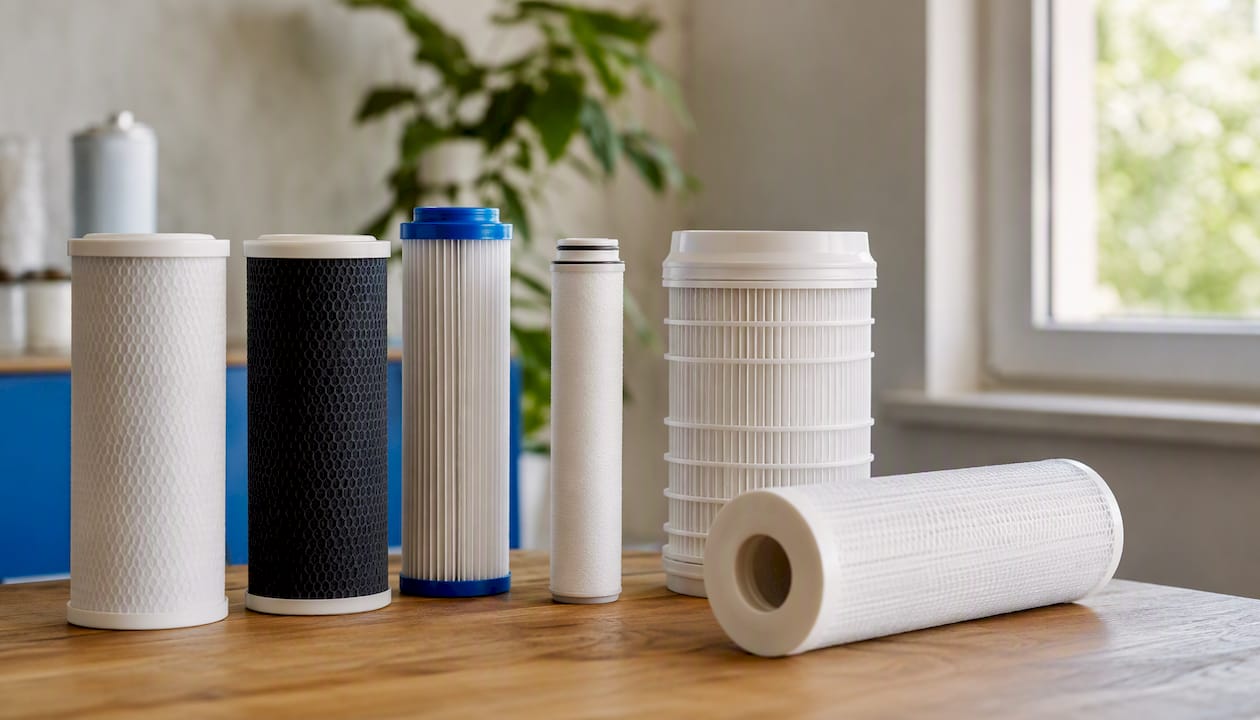
The standard numbers are not a ranking — they reflect the order in which NSF developed them. NSF/ANSI 42, 53, 58, and 401 are the four most relevant for most consumer filter purchases, with 44, 177, 244, and 61 covering specific product types or materials.
| Standard | What it evaluates | Typical product types |
|---|---|---|
| NSF/ANSI 42 | Aesthetic effects: chlorine taste/odor, particulates (Class I–V), zinc | Pitcher, faucet, refrigerator, whole-house |
| NSF/ANSI 53 | Health-related contaminants: lead, cysts, VOCs, arsenic, and others | Pitcher, faucet, under-sink, whole-house |
| NSF/ANSI 58 | Reverse osmosis systems: TDS reduction, membrane performance, system components | Under-sink RO, countertop RO |
| NSF/ANSI 401 | Emerging/incidental contaminants: pharmaceuticals, herbicides, PFOA/PFOS, BPA | Pitcher, faucet, under-sink |
| NSF/ANSI 44 | Cation exchange water softeners: hardness reduction, barium, radium | Whole-house softeners |
| NSF/ANSI 177 | Shower filtration systems: free chlorine reduction | Showerhead filters |
| NSF/ANSI 244 | Microbiological purifiers: bacteria, viruses, cysts | Countertop, under-sink, portable |
| NSF/ANSI 61 | Drinking water system components: materials safety only, no reduction claims | Pipes, fittings, valves, media |
A few practical notes on what these certifications mean in your home:
- NSF/ANSI 53 with a lead claim means the filter was tested to reduce lead to 10 ppb or 5 ppb (the EPA recommends verifying the 5 ppb target for lead reduction) at a defined challenge concentration, for the stated gallon capacity
- NSF/ANSI 58 covers the whole RO system, not just the membrane — look for it when buying any under-sink reverse osmosis unit
- NSF/ANSI 61 on a pipe fitting means the material is safe for contact with drinking water; it says nothing about what the fitting removes
- NSF/ANSI 244 is the standard to prioritize if you’re on a private well or face intermittent boil-water advisories, since it covers purifiers that reduce bacteria and viruses
NSF’s water filtration certification pages list certified products and their Performance Data Sheets, so you can cross-reference any standard number you see on packaging against the actual tested claims.
How filter testing and performance claims actually work
Certification verifies performance against specific test methods and influent challenge levels — meaning the lab spikes water with a known concentration of a contaminant, runs it through the filter at a defined flow rate, and measures what comes out. That number is what appears on the Performance Data Sheet.
What a typical test protocol measures:
- Influent challenge concentration: the contaminant level in the test water (e.g., 150 ppb lead, 2 mg/L chlorine)
- Flow rate: gallons per minute at which the filter was tested
- Rated capacity or service life: total gallons (or time) the filter was tested to maintain its reduction claim
- Particulate class: for sediment filters, Class I removes the finest particles (0.5–1 micron); Class V removes the coarsest (nominal 80 micron)
- Percentage reduction or target output: either a percentage (e.g., “reduces chlorine by 97%”) or a target output level (e.g., “reduces lead to ≤10 ppb”)
The Performance Data Sheet is where all of this lives. Packaging typically shows the certifier mark and a summary claim. The sheet — included in the product box or listed in the NSF certified DWTU directory — shows the tested contaminants, the challenge concentration, the reduction percentage or target, and the rated capacity for each claim. A filter might be certified to reduce lead and chlorine taste, but at different capacities for each claim. That distinction only appears on the sheet.
Statistic callout: The NSF DWTU directory lists model-level claims and provides service-life data summaries for certified drinking water treatment units, giving consumers a direct way to verify what any specific model was tested to do before purchase.
Model-level verification matters because the same brand can sell multiple filter models with different certifications. A pitcher’s base model might carry NSF/ANSI 42 only; an upgraded version might add NSF/ANSI 53 for lead. The brand name alone tells you nothing — the model number does.
Step-by-step: how to verify a filter’s certification before you buy
The fastest verification path is a model-level lookup in a certifier’s online directory, cross-referenced with the product’s Performance Data Sheet. Here’s the full process:
- Find the exact model number. It’s on the filter housing, the box, or the replacement cartridge packaging. Brand name alone is not enough.
- Search the NSF Certified DWTU directory at info.nsf.org/Certified/DWTU/. Filter by standard number (e.g., NSF/ANSI 53) and enter the model number. If it appears, the certification is current.
- Open the Performance Data Sheet linked in the directory listing or included in the product box. Confirm the specific contaminants tested, the reduction percentage or target output, and the rated capacity for each claim.
- Verify the exact claim matches your concern. A filter certified to NSF/ANSI 53 for cysts is not certified for lead unless lead appears separately on the Performance Data Sheet.
- Check the certifier mark on the packaging. It should name the certifier (NSF, UL, WQA, IAPMO) and the specific standard number. Vague text like “meets NSF standards” without a number is not a certification claim.
- Confirm the certifier is ANSI-accredited if you’re unsure. NSF, UL Solutions, IAPMO R&T, and WQA are all ANSI-accredited and widely recognized. UL Solutions documents its own accreditation and overlap with NSF/ANSI standards for reference.
For second-hand or unlabeled filters:
- Search the serial number or contact the manufacturer directly to request the model’s certification status
- If the manufacturer cannot provide a current certifier directory listing and a Performance Data Sheet, treat the filter as uncertified
- Buying a used filter without documented certification is a real risk — filter capacity may be exhausted and claims unverifiable
How to read certification marks, packaging text, and the Performance Data Sheet
The correct label format reads something like: “Tested and Certified by [Certifier Name] against NSF/ANSI Standard [Number] for the reduction claims specified on the Performance Data Sheet.” That sentence, or a close equivalent, paired with the certifier’s logo, is what legitimate certification looks like on packaging.
Watch for this gap: a certifier mark on the box confirms the product line was tested. The Performance Data Sheet confirms the specific model and specific claims. These are two different levels of proof, and only the second one tells you what the filter actually does for your water.
Certifier marks appear on the outer box, the filter housing itself, and sometimes the smallest retail unit. Claims, however, often appear only on the Performance Data Sheet inside the box or in the certifier’s online listing. This is why checking the directory before you buy is worth the two minutes it takes.
Red flags to watch for on packaging:
- “Meets NSF standards” with no standard number listed
- “NSF-tested” without a certifier name or model-level reference
- A standard number listed without a specific contaminant claim (e.g., “NSF/ANSI 53 certified” without naming what health contaminant was tested)
- Certifier marks that don’t appear in any ANSI-accredited certifier’s online directory when you search the model number
Multiple certifier marks on one product are fine — a filter can be certified by WQA to NSF/ANSI 42 and by NSF to NSF/ANSI 53, for example. What matters is that each mark links to a model-level listing in that certifier’s directory, with a corresponding Performance Data Sheet for each standard.
Identifying filters certified to reduce PFAS
For PFAS, use certifier directories and EPA guidance rather than packaging alone. PFAS claims are evolving rapidly, and a filter marketed as “PFAS-reducing” may not have been tested to a validated method for the specific PFAS compounds in your water.
Steps to verify a PFAS reduction claim:
- Search the NSF Certified DWTU directory and filter by NSF/ANSI 401, which covers some PFAS compounds including PFOA and PFOS
- Check whether the Performance Data Sheet references any elective PFAS test methods beyond the standard 401 list — some manufacturers pursue additional testing for PFAS compounds not yet covered by a formal standard
- Cross-reference with EPA’s PFAS filter guidance, which identifies certifier listings and validated test methods for specific PFAS compounds
- Do not rely on packaging text like “reduces PFAS” without a standard number and a certifier directory listing to back it
The PFAS certification picture is genuinely incomplete right now. NSF/ANSI 401 covers PFOA and PFOS, but there are thousands of PFAS compounds, and test methods for many of them are still being developed. A filter certified to NSF/ANSI 58 (reverse osmosis) or NSF/ANSI 244 may also reduce a broader range of PFAS compounds, but the specific claims depend on what the manufacturer elected to test. When PFAS is your primary concern, the certifier directory and the Performance Data Sheet are the only reliable sources — not the front of the box.
When to prioritize which certifications: use local water data to decide
Pick certifications based on the contaminants your water is most likely to contain. Here’s a practical decision framework:
-
Lead is your concern (older home, pre-1986 plumbing, city with known lead service lines): prioritize NSF/ANSI 53 with an explicit lead reduction claim to 5 ppb. Check lead levels in your state before you shop — states like Michigan, Massachusetts, and Connecticut have documented lead issues in specific utilities. The Safe Drinking Water Act sets the action level at 15 ppb, but health advocates and EPA guidance both point to 5 ppb as the target for certified filter performance.
-
PFAS is your concern (near industrial sites, military bases, or areas with known PFAS detections): start with NSF/ANSI 401 certified models, then check whether the manufacturer has pursued additional elective PFAS testing. Reverse osmosis systems certified to NSF/ANSI 58 often reduce a broad range of PFAS compounds — verify the specific claims on the Performance Data Sheet.
-
You’re on a private well or face intermittent boil-water advisories: NSF/ANSI P231 (microbiological purifiers, older designation) or NSF/ANSI 244 (current standard for purifiers reducing bacteria, viruses, and cysts) is the relevant certification. Standard 53 covers cyst reduction but not viruses.
-
Chlorine taste or odor is the main issue (common in municipal water): NSF/ANSI 42 is sufficient for this concern and is widely available in pitchers and faucet filters at lower price points.
-
You want broad coverage: an RO system certified to NSF/ANSI 58, paired with a carbon pre- or post-filter certified to NSF/ANSI 42, covers TDS, many health contaminants, and aesthetic effects in one setup. Confirm each component’s certification separately — the membrane and the carbon stage may carry different certifications.
Pro Tip: Before you buy anything, run your ZIP code or utility name through Tapwaterindex to see which contaminants have been detected in your local water supply. That report tells you which NSF/ANSI standards to prioritize — and which ones you can skip.
What actually matters when certifications feel confusing
The practical rule of thumb: match the standard to the contaminant, verify at the model level, and replace the filter on schedule.
Marketing language around water filters is genuinely noisy. Brands use “NSF certified” as a trust signal without always making clear which standard applies or what was tested. After reading through the standards and the verification process, the pattern becomes clear: the certification mark is the starting point, not the proof. The Performance Data Sheet is the proof.
Model-level verification sounds like extra work, but it takes about two minutes in the NSF DWTU directory. That two minutes is the difference between knowing your filter was tested to reduce lead to 5 ppb at 150 ppb challenge concentration for 400 gallons, and assuming it does because the box has a logo on it.
One more thing worth saying plainly: a certified filter that’s past its rated capacity is no longer performing to its tested claims. The certification doesn’t expire, but the filter’s performance does. Replace cartridges on the schedule the Performance Data Sheet specifies, not when the water starts tasting different.
Check your local water before choosing a certified filter
Knowing which NSF/ANSI standards to prioritize is much easier once you know what’s actually in your tap water. Tapwaterindex pulls from official EPA monitoring data to show you exactly which contaminants have been detected at your utility, at what levels, and how those compare to EPA limits.
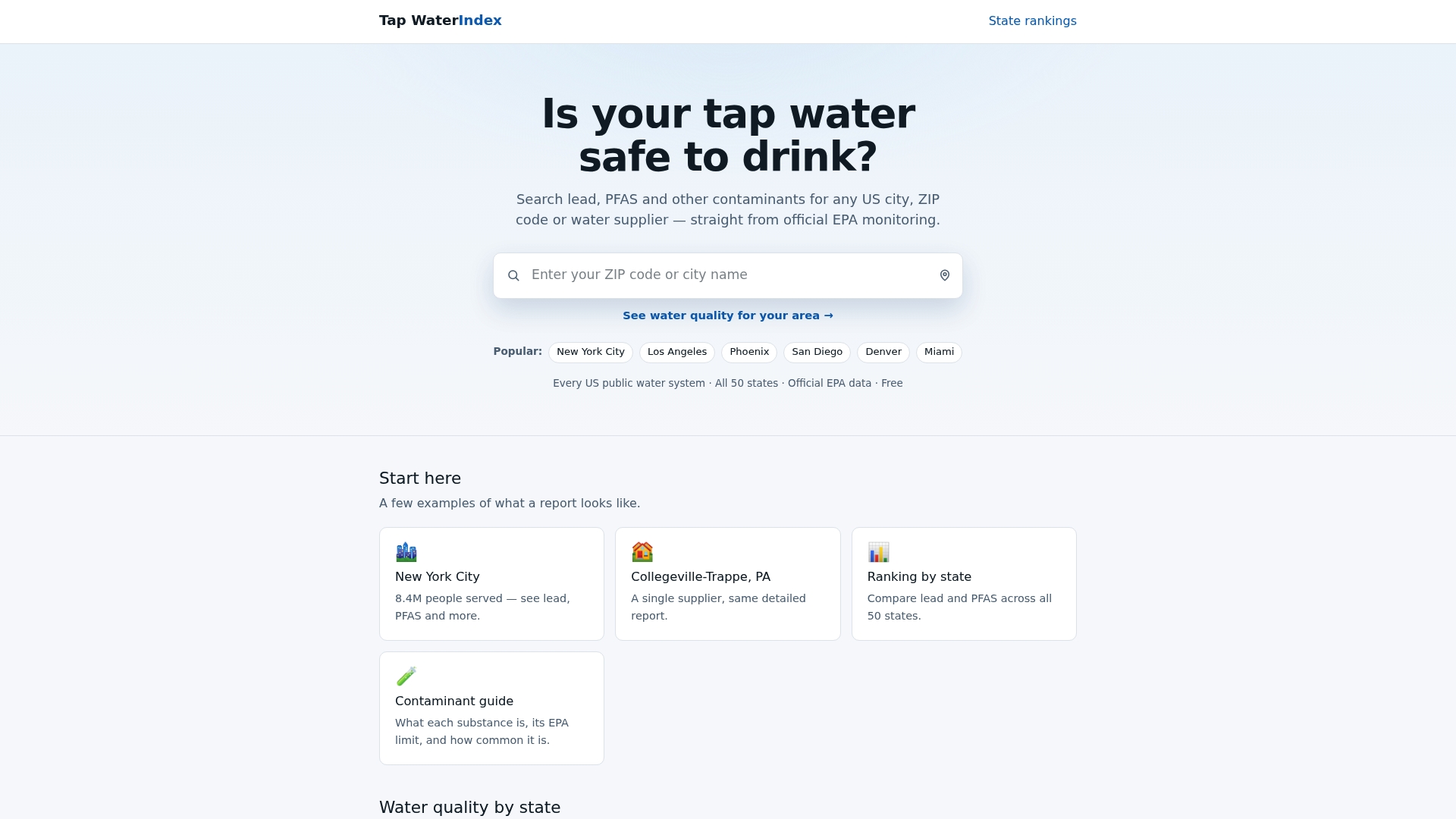
If your local report shows lead detections, you know NSF/ANSI 53 is non-negotiable. If it shows PFAS, you know to look for NSF/ANSI 401 listings and elective PFAS testing. If your water is clean on both fronts, a basic NSF/ANSI 42 filter for taste and odor may be all that you need. The state-by-state water quality rankings give you a starting point, and the utility-level search at Tapwaterindex gets you to the specific contaminant data for your address. Check your local results first, then use this guide to match the right certification to what you find.
Sources
- Consumer tool for identifying point-of-use and pitcher filters certified to reduce lead in drinking water | EPA (June 2024)
- Search for NSF Certified Drinking Water Treatment Units (NSF certified DWTU directory)
- Water filtration: testing and certification | NSF
- Identifying drinking water filters certified to reduce PFAS | EPA